
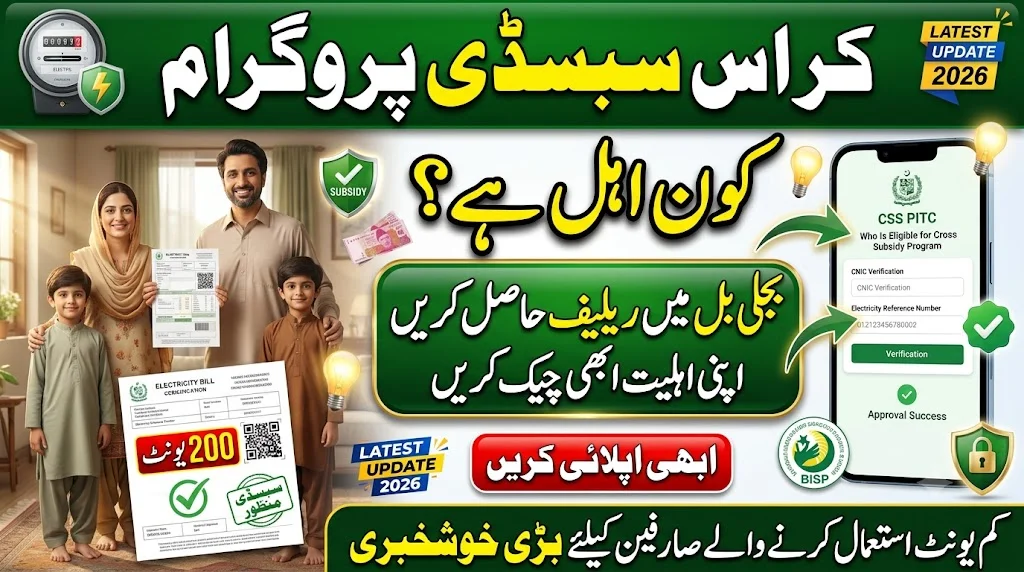
Electricity bills have become one of the biggest problems for families across Pakistan. Almost every month, people wait nervously for the bill because even small households are now receiving unexpectedly high charges. That’s why thousands of consumers are searching for the Cross Subsidy Program Electric Bill Relief CSS PITC to see whether they qualify for financial support or not.
Many people already know about the registration process, but the real question is:
Who is actually eligible for the Cross Subsidy Program?
I recently helped a few people check their eligibility, and I noticed most consumers are confused about the 200-unit condition, BISP connection, and household requirements. Some families think everyone can apply, while others assume the program only supports BISP users.
To make things simple, this guide explains the complete Cross Subsidy Program eligibility criteria, who can apply, who may not qualify, and how the CSS PITC system checks consumers.
What Is Cross Subsidy Program Electric Bill Relief CSS PITC?
The Cross Subsidy Program CSS PITC is a digital electricity relief system designed to support low-income electricity consumers in Pakistan.
Instead of giving equal subsidy to every consumer, the system tries to provide targeted support to families who genuinely need financial help.
The program mainly focuses on:
- Low electricity users
- Economically struggling households
- BISP beneficiaries
- Deserving families facing high electricity costs
Verification is usually completed through the official CSS PITC portal using consumer electricity records and CNIC information.
Why Eligibility Rules Matter in This Program
The government introduced eligibility conditions to ensure subsidy support reaches deserving households instead of high-income consumers.
For example, two families may both use electricity, but their financial situations can be completely different.
One family may struggle to pay basic bills, while another may easily afford heavy electricity usage. That’s why the system checks multiple details before approval.
Main Eligibility Criteria for Cross Subsidy Program CSS PITC
Although final approval depends on official verification, these are the most common conditions connected with eligibility.
1. Electricity Usage Should Be Low
The biggest condition most people talk about is the 200-unit limit.
Consumers using around:
- 200 units or less
may receive higher priority during verification.
Lower electricity usage usually indicates smaller or financially struggling households.
Families using heavy appliances regularly may not qualify easily.
2. Consumer Must Have Active Electricity Connection
Your electricity meter and consumer account should remain active.
The system checks whether:
- The connection exists properly
- Billing history is available
- The consumer account is valid
Disconnected or inactive accounts may face verification problems.
3. Valid CNIC Information Is Important
Applicants must provide correct CNIC details during verification.
Many people accidentally type:
- Wrong CNIC digits
- Expired CNIC details
- Incorrect personal information
Even small mistakes can create rejection or verification delays.
4. Low-Income Families Receive Priority
The program mainly targets households struggling financially.
Families with limited income may have better chances compared to high-income consumers with expensive assets or heavy electricity consumption.
5. BISP Beneficiaries May Get Preference
Consumers already connected with:
- Benazir Income Support Programme (BISP)
- Similar welfare programs
may receive preference because their records already exist in government systems.
However, BISP registration alone does not automatically guarantee approval.
Who May Not Qualify for Cross Subsidy Program?
Many users search for eligibility but ignore disqualification factors.
Usually, these consumers may face lower approval chances:
Heavy Electricity Users
Consumers using very high electricity units regularly may not fall under the deserving category.
Commercial Electricity Connections
Shops, businesses, and commercial meters usually do not receive the same subsidy support as domestic consumers.
Incorrect Consumer Information
Wrong details in:
- CNIC
- Reference number
- Mobile number
- Consumer account
can create verification failure.
High-Income Households
Families with expensive assets, large property ownership, or financially strong records may not qualify under targeted relief systems.
How CSS PITC Checks Eligibility
The verification system is mostly digital.
The portal may review:
- Electricity consumption history
- Consumer billing data
- CNIC records
- Household information
- Government database matching
This process helps reduce fake applications and manual errors.
How To Check Your Eligibility Online
Many consumers don’t realize the checking process itself is very easy.
Basic Steps Usually Include
- Open official CSS PITC portal
- Enter electricity reference number
- Add CNIC details
- Complete verification
- Wait for response or SMS update
Some electricity bills also include QR codes for faster verification access.
Common Mistakes That Affect Eligibility
While helping relatives use the portal, I noticed several repeated mistakes.
Avoid These Errors
- Entering wrong reference number
- Using inactive mobile number
- Applying through fake websites
- Typing incorrect CNIC details
- Submitting incomplete forms repeatedly
One wrong number can delay the entire process.
Can Consumers Reapply If Rejected?
Sometimes consumers become ineligible because of outdated records or incomplete information.
If household conditions change later, some users may try verification again after updating official records.
However, approval always depends on final government verification.
Why Low Electricity Consumers Are Getting More Attention
The government introduced targeted electricity relief because subsidy costs have increased heavily over the years.
Instead of supporting all consumers equally, the system focuses more on families genuinely struggling with inflation.
For many low-income households, even small electricity bill reductions help manage:
- Grocery expenses
- Medicines
- School fees
- Household costs
That’s why limited electricity usage is considered an important factor.
Important Safety Tips for Applicants
Unfortunately, fake pages and scams are increasing rapidly around subsidy programs.
Always Remember
- Registration is free
- Never pay agents for approval
- Use official CSS PITC portal only
- Ignore fake social media guarantees
- Do not share sensitive information carelessly
Scammers often target people searching for financial relief online.
Frequently Asked Questions (FAQs)
Who is eligible for Cross Subsidy Program Electric Bill Relief CSS PITC?
Mostly low-income households, BISP beneficiaries, and consumers using around 200 units or less may qualify.
Is 200 units mandatory for approval?
Lower unit consumption usually receives priority, but final verification depends on multiple factors.
Can BISP families apply?
Yes, many BISP-connected households may qualify for subsidy verification.
Can commercial users apply?
Commercial electricity connections generally do not receive the same subsidy support as residential users.
Is the verification process free?
Yes, official registration and verification are free.
Final Thoughts
After personally checking how the Cross Subsidy Program Electric Bill Relief CSS PITC system works, one thing is very clear — the program mainly focuses on genuinely deserving electricity consumers struggling with rising bills.
Families using limited electricity, maintaining correct records, and meeting financial conditions may have better chances of approval. The most important thing is using accurate information and staying away from fake agents or unofficial websites promising guaranteed subsidy approval.